 Arriving with the Chedester family, I was welcomed to a weekly team meeting dinner party. Today’s menu: brick-oven roasted pizza, plain cheese to supreme and everything in between. Not that I dislike east African cuisine, in fact I very much enjoy the native dishes, especially the charcoal barbequed bush meet speared and sold on the street. From the bus window, I would spend the thousand Ugandan Shillings (~.65 cents USD) for two long toothpick-like skewers knowing very well my digestive track would hate me for it that night and day after. But a change in menu is very appetizing, especially a taste from home. Odd I would find it here far removed from anything near western civilization, and better tasting than most pies back at home. After a brief astronomy lesson navigating around tree canopies, followed by an episode of Band of Brothers on DVD, Scott and I sat across from each other in the family living room and talked about Ebola.
  I looked at my arms; the skin looked like a few dozen mosquitoes had bitten me. The pink blotches in fact were bukukuni bites, a gnat-like fly with a taste for human skin. Bob had warned me earlier about wearing a long sleeve shirt at night, and that in conjunction with not taking his advice about getting on an empty bus because it won’t be leaving anytime soon (that morning, resulting in a three hour departure wait), were now two things I should have listened to.
“Don’t say too much, you’ll end up repeating it,” Jennifer suggested from the kitchen, switching off the lights. Jack, Julia and Caleb, three of the Myhre’s four kids had already retired on the school night. The next day would be a whirlwind event at the school celebrating Parents Day, which in addition to their respective doctor roles at two different local institutions, both Scott and Jennifer are heavily involved with the school’s development.
“I, Dr. Sessanga, and Dr. Jonah were in the room together looking over Jeremiah Muhindo’s chest x-ray trying to figure out what was causing the illness, this was before knowing it was Ebola,” Scott recounted the days just before the announcement. “He was having shortness of breath, his eyes were real red, and I remember putting my hand on his hand to check his pulse. His hands were just cold as ice; the man was in shock. We all came in contact with the patient. In a way, it’s not fair two of the three of us would get Ebola, and one of us would die.” “Were you afraid?”

“After Jonah got sick and Sessanga gets sick, then Ebola is confirmed … I was afraid. It was right at that point we decided we had both been exposed because of our visit to Kikyo and having been in contact with a number of patients that had died, we had twenty-one days to determine if we were developing symptoms or not and decided we needed to send our kids away from us. If we got sick, we didn’t want to expose them.”
“What were you going through those twenty-one days?” I feel like the answers to my questions are obvious, but I needed to ask. Scott and later Jennifer were pros; going beyond what I thought was an obvious response.
“You’re super-sensitive. After Jonah was buried, I was sitting at church and had a headache. I don’t usually get headaches. I leaned over to Jennifer and said, ‘I just don’t feel well,’ and she said, ‘Well go home and go to bed.” There was a knowing exchange of looks that this… and I laid down and I thought, ‘Well, this could be it.’ And I told her, if I really felt like I was sick, I was going to go across the street to a vacant missionary house and lock myself in there, because I wasn’t going to have her take care of me and expose herself and leave our kids as orphans. Nothing ever came of that, but I talked to an MSF worker [Doctors Without Borders] and she said that, ‘Typically if you do come down with Ebola this late after contact, you’ll get sick, but probably not die of it.’”
“You’re super-sensitive. After Jonah was buried, I was sitting at church and had a headache. I don’t usually get headaches. I leaned over to Jennifer and said, ‘I just don’t feel well,’ and she said, ‘Well go home and go to bed.” There was a knowing exchange of looks that this… and I laid down and I thought, ‘Well, this could be it.’ And I told her, if I really felt like I was sick, I was going to go across the street to a vacant missionary house and lock myself in there, because I wasn’t going to have her take care of me and expose herself and leave our kids as orphans. Nothing ever came of that, but I talked to an MSF worker [Doctors Without Borders] and she said that, ‘Typically if you do come down with Ebola this late after contact, you’ll get sick, but probably not die of it.’”
 The following morning, Scott drove me the thirty minutes to Bundibugyo hospital. We stopped
 at the  gravesites of the four healthcare workers, including
  Dr. Jonah Kule, whom died caring for Ebola patients during the outbreak.
“Not many people came to Jonah’s burial in fear of getting Ebola. Afraid they might get Ebola from the air, or from the bodies. It doesn’t help to see the MSF burial team, dressed in their Tyvex spacesuits disinfecting the bodies sealed in bags then dropping the coffins into their graves,” Scott quietly explained before he and I walked across the medical campus. Men and women of all ages loitered through the open covered pathways. Some women waited outside the x-ray building for an ultrasound. Some just sat on the sidewalk ends looking at the many people passing by. Through the antenatal ward where the Ebola infected healthcare workers we treated, an education workshop was underway. Nurses sifted through disorganized books and records; I honestly couldn’t guess what was going on. Over a shallow hill of drying grass took us to a chain link fence enclosing the isolation ward.
gravesites of the four healthcare workers, including Dr. Jonah Kule, whom died caring for Ebola patients during the outbreak.“Not many people came to Jonah’s burial in fear of getting Ebola. Afraid they might get Ebola from the air, or from the bodies. It doesn’t help to see the MSF burial team, dressed in their Tyvex spacesuits disinfecting the bodies sealed in bags then dropping the coffins into their graves,” Scott quietly explained before he and I walked across the medical campus. Men and women of all ages loitered through the open covered pathways. Some women waited outside the x-ray building for an ultrasound. Some just sat on the sidewalk ends looking at the many people passing by. Through the antenatal ward where the Ebola infected healthcare workers we treated, an education workshop was underway. Nurses sifted through disorganized books and records; I honestly couldn’t guess what was going on. Over a shallow hill of drying grass took us to a chain link fence enclosing the isolation ward.
We walked around the two-car garage-sized building to an unlocked door. I walked inside.
Sunlight seeped through a gap where the wall would meet the floor, and from the middle seam between blue painted wooden window panels. Eight bed frames, four on each side are planted on the grey polished cement floor, their white latex coatings peeling from its metal bars. I visualized the beds made and occupied. A suited individual examines one patient through his plastic helmet mask and thick blue gloves, checking the still individual’s pulse and examining his eyes.
Sunlight seeped through a gap where the wall would meet the floor, and from the middle seam between blue painted wooden window panels. Eight bed frames, four on each side are planted on the grey polished cement floor, their white latex coatings peeling from its metal bars. I visualized the beds made and occupied. A suited individual examines one patient through his plastic helmet mask and thick blue gloves, checking the still individual’s pulse and examining his eyes.
“I was partially conscious, but not alert to all my senses,” one Ebola survivor told me. “I would not be able to drink. I would not be able to turn my body. I would sleep like that until someone could assist me. The thinking was not so easy. You could think of either surviving or death. And you just hand everything to God to decide on your fate.”
 I then pictured myself inside one of those Tyvex suits and contending with the heat and humidity compounded underneath the protective garment. Leaving the isolation ward, I further imagined drenching myself with a concentrated bleach solution in one of the many white tents established by the MSF team, sealing the suit in a biohazard bag before redressing into my clothes and allowing the thickness of the air become a sad refreshing relief.
“You. What are you filming? What are you doing here?” a burly man in a suit approached me mounting the back of a motorcycle, the camera gripped tightly by my left hand over my lap.
Denato spoke to him, but the man ignored whatever was said stepping over banana bundles charging forward. People in the market stopped in mid-commerce to witness the exchange. In particular, I recall one older woman holding a food item frozen in transaction.
Being the only mzungu around draws enough attention, regardless of the few white families residing on the outskirts of town. But a mzungu with a camera rivaling anything the country begs special attention whether by lens happy children or protective elders.
“I ask you, why are you here?” The man stood dangerously close. I looked to Denato; no more help there.
“I’m filming a documentary,” I calmly stated, knowing I’m not going anywhere unless I direct Denato to drive.
“What again?”
“A documentary on the Ebola outbreak here last year.”
“On Ebola?”
“Yes.”
He smiled. And almost immediately, his whole body relaxed and he said shaking my hand, “Oh, that is good. Thank you. Welcome. Be free, you are welcome here.”
I then pictured myself inside one of those Tyvex suits and contending with the heat and humidity compounded underneath the protective garment. Leaving the isolation ward, I further imagined drenching myself with a concentrated bleach solution in one of the many white tents established by the MSF team, sealing the suit in a biohazard bag before redressing into my clothes and allowing the thickness of the air become a sad refreshing relief.“You. What are you filming? What are you doing here?” a burly man in a suit approached me mounting the back of a motorcycle, the camera gripped tightly by my left hand over my lap.
Denato spoke to him, but the man ignored whatever was said stepping over banana bundles charging forward. People in the market stopped in mid-commerce to witness the exchange. In particular, I recall one older woman holding a food item frozen in transaction.
Being the only mzungu around draws enough attention, regardless of the few white families residing on the outskirts of town. But a mzungu with a camera rivaling anything the country begs special attention whether by lens happy children or protective elders.
“I ask you, why are you here?” The man stood dangerously close. I looked to Denato; no more help there.
“I’m filming a documentary,” I calmly stated, knowing I’m not going anywhere unless I direct Denato to drive.
“What again?”
“A documentary on the Ebola outbreak here last year.”
“On Ebola?”
“Yes.”
He smiled. And almost immediately, his whole body relaxed and he said shaking my hand, “Oh, that is good. Thank you. Welcome. Be free, you are welcome here.”
Not quite the reaction I expected, but a welcome one. Denato, Scott’s assistant, revved the engine and I prepped the camera to film over the driver’s head while riding the uneven dirt road. Even after replaying the footage days later, I’m still shocked at myself for putting faith into a motor bike and its driver at the stake of breaking my camera—or injuring myself. I did  regretfully pack the camera for the thirty-minute return drive back to the Myhre’s on a motor-boda. Over steep inclines and sharp drops, dodging people and potholes, the choice was probably a good idea, although the mountain and valley views were breathtaking.
 In her blog, Jennifer drew a parallel between the Ebola and HIV viruses, “HIV attacks the disease-fighting cells of the body, so that a person succumbs to other illnesses. Few AIDS patients are technically killed by the HIV virus alone, almost all die from things like TB or fungi or common bacterial infections that can no longer be resisted. On a macro level, Ebola acts in a similar way. Ebola attacked the disease-fighting personnel and programs of this society. Only 37 people died of Ebola during the epidemic, but many more, untold numbers, have died because of the lack of medical services. I think we will never really know the true impact.”
*Pictures from the 2007 outbreak courtesy Scott and Jennifer Myhre.
regretfully pack the camera for the thirty-minute return drive back to the Myhre’s on a motor-boda. Over steep inclines and sharp drops, dodging people and potholes, the choice was probably a good idea, although the mountain and valley views were breathtaking.In her blog, Jennifer drew a parallel between the Ebola and HIV viruses, “HIV attacks the disease-fighting cells of the body, so that a person succumbs to other illnesses. Few AIDS patients are technically killed by the HIV virus alone, almost all die from things like TB or fungi or common bacterial infections that can no longer be resisted. On a macro level, Ebola acts in a similar way. Ebola attacked the disease-fighting personnel and programs of this society. Only 37 people died of Ebola during the epidemic, but many more, untold numbers, have died because of the lack of medical services. I think we will never really know the true impact.”*Pictures from the 2007 outbreak courtesy Scott and Jennifer Myhre.


 Four brothers ascend into the Rwenzori Mountains, crossing orchards of cocoa trees, coffee and kasava to reach the untouched woodlands approaching national park land. The sky is most likely clouded over from their perspective, but through the cold mist, not much ahead is seen other than the dense forest at arm’s reach. Perhaps the monkey was already dead when they found it, or maybe out of hunger or pleasured desire they killed and then consumed the mammal together.
 road around and through the Rwenzori Mountains.
 By thirty and thirty-one, we arrived at what must have been the most anticipated destination on the
  Jonah was a man of integrity. He refused to charge patients extra fees for his services, even though that is widely practiced in government hospitals. He was completely trustworthy with his responsibilities and resources. He was a leader who knew how to motivate, listen, draw consensus. He was not afraid.
 A Maasai herds-boy bowed his head in passing. I laid my hand atop of his head and continued forward. I had made the mistake of shaking a child’s hand in greeting early in the visit. Shaking one’s hand is a ritual reserved for adults in the Maasai tribe— those having passed the rite of manhood (or womanhood) through an annual community public circumcision ceremony for adolescents aged 14-17 followed by a month of isolation together into the bush. Wearing nothing but animal skins, the boys are mentored by the generation previous to become fearless adults under the influence of intense “medicine”. The details are kept secret, and for this herds-boy, he must continue to bow his head in respect aspiring to prove he is ready to be a man.
 The name Transmara is indicative to its meaning. The area is a transition zone between the mountainous Rift Valley and the low-lying savannahs. “Mara”, a Maasai word for “spotted”, refers to the sporadic grouping of trees dotting the land similar to the spots on a leopard or cheetah. From above, a word for “checkered” would be more appropriate, as farming has quartered the grassy hills like a relief chess board. I spotted the school Emmanuel is building on the slope of another hill and where I played football with the primary-grade students at break.
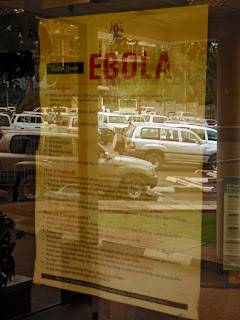 A thirty-minute ten-kilometer taxi ride brought us to the front entrance of the Ugandan Ministry of Health. Taped to a window is a yellow poster titled from small print to bold:
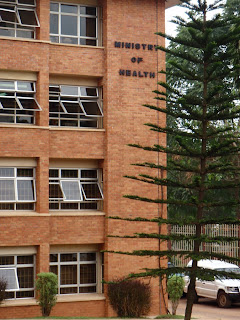 Marburg hides and Ebola hopefully soon to come. This is a historical time forty years in the making. But beyond that, this documentary is not necessarily about the virus itself, but the human story behind dealing with it,” I explained and continued with the current plan. “Right now, I’m establishing the contacts and gathering the necessary knowledge so when I get the phone call that something is happening in … the Congo, I’m prepared to move forward immediately and mobilize my crew to best achieve our purpose.”
 Echoing around me, the cries and whooping of short screeches and dull fluttering quickly escalated in volume. I turned my light to the vaulted ceiling and caught the glitter of hundreds paired rusty-gold blinking beads.
 “When do the elephants come around?” I asked.
 From the top of Endebess bluff we watched the late afternoon bring its routine seasonal downpour to Elgon’s east facing forested slopes and the endless crop fields dipping below the horizon. In timelapse, the clouds develop and expand over the world’s broadest mountain slope returning to the valley with brief but sometimes drenching rain. Upon clearing, the mass movement of bushbucks, dik-diks and baboons roll past our banda’s doorstep near the park’s entrance below. Dusk passes and the clouds part revealing a moon-washed southern Milky Way overhead. Like last summer, Jupiter graced its yellow brilliance at zenith now positioned on the handle side of the teapot shaped constellation, Sagittarius. Although being just north of the equator, I noted the north and south poles at the horizon and from my seat beside the fire and watched the sky rotate directly toward the west. I discussed elementary (college) astronomy to a skeptical Carolyn and quiet Michelle. Both girls were volunteering at Sister Freda’s for the month, and knew Tyler from last summer’s volunteer work in Transmara; our next and last destination.
 “I was hearing some youths that were saying that after their parents running away, that they have no food to eat, so they thought that it was good to join the militia so that they can steal the cattle and eat in the bush. Others were forced to join the militia because if you are a youth and you do not join the SLDF, it is better that you go outside Mount Elgon,” Crispin, a Pasteur in Mt. Elgon church community explained to us.
 after twenty-one days in the pit latrine, removed him and buried him. Those people [SLDF] called me and used a private number and they told me the direction where they damned my nephew.”


